12 Time-Saving Corporate Travel Tips That Actually Work [2026]
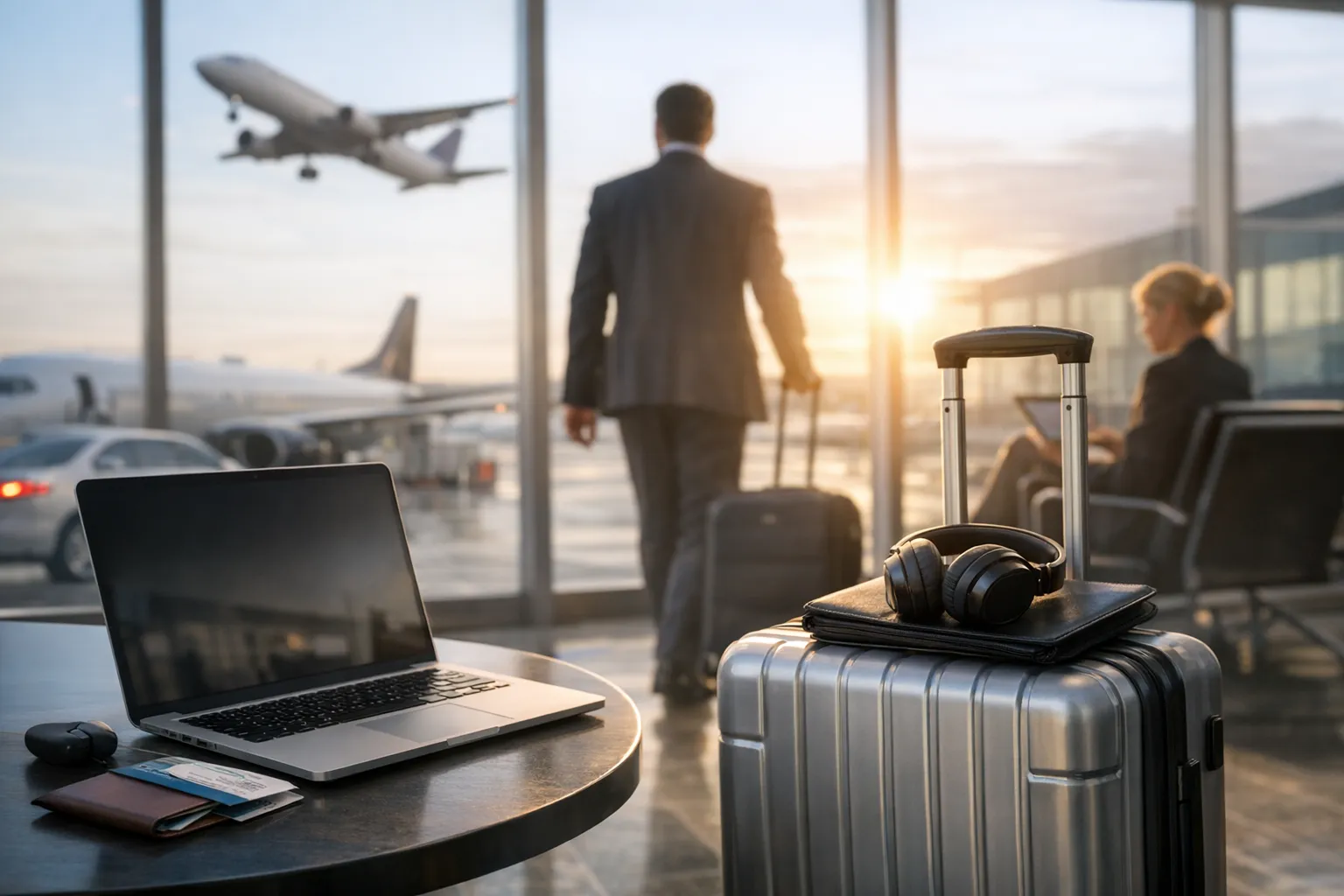
Corporate travel is a zero-sum game with your calendar. Every minute lost to a delayed pickup, a missed lounge access window, or a dead phone at gate B12 is a minute you’re not closing deals, managing your team, or sleeping.
This guide is for Sarah—the travel manager juggling 20 executive trips a month—and for every road warrior who knows the difference between a 42-minute airport connection and a 38-minute one.
These are not the obvious tips. You already know to “arrive early.” What follows are 12 specific, tested strategies that actually move the needle in 2026.
Why Most Corporate Travel Advice Doesn’t Work
The travel productivity advice you find on most blogs was written in 2018 and hasn’t been updated since. It ignores AI planning tools, the post-pandemic shift in airport staffing, the explosion of same-day booking apps, and the simple truth that ground transportation—not the flight itself—is where most business travelers lose their time.
The 12 tips below are calibrated for how corporate travel actually works right now.
Tip #1: Pre-Book Your Ground Transportation 48 Hours in Advance
This is the single highest-leverage change a travel manager can make. And it’s the one most people still get wrong.
Here’s the math: A rideshare from JFK to Midtown Manhattan during morning peak hours can mean a 15–25 minute wait for a driver, a car that doesn’t match your needs, surge pricing that blows your per-diem, and a driver unfamiliar with your terminal. That’s before you’ve left the airport.
Pre-booking a dedicated corporate car service like CoreCar locks in your vehicle, your price, and your meet-and-greet time before you land. Your driver tracks your flight in real time and adjusts if you’re early or delayed. You walk off the plane and into a waiting car—no app-juggling, no price negotiation, no wondering if the “4.7 star” driver actually knows how to find Terminal 4 arrivals.
For travel managers specifically: services like CoreCar offer account management, centralized billing, and trip reporting that integrates directly with expense platforms. One invoice per month instead of 40 individual receipts.
Tool to use: CoreCar (tri-state area, all NYC-area airports including JFK, LGA, and EWR). Book at corecar.com or via phone for same-day availability.
Tip #2: Use AI Tools to Compress Your Pre-Trip Research
Planning a multi-city trip used to take 45 minutes of cross-referencing. In 2026, it takes 8.
Use ChatGPT or Claude to build your itinerary framework fast: “I’m traveling from Newark to Chicago O’Hare to Dallas Love Field over 3 days, leaving Monday morning. What are the optimal flight windows, layover minimums, and hotel neighborhoods to stay in for each city?” You’ll get a workable skeleton in under 60 seconds.
Pair that with Google Flights’ price tracking alerts. Set alerts for your most common routes and you’ll know within hours if a better fare appears—especially useful when a client trip is still 3 weeks out and prices are volatile.
Tools to use: ChatGPT-4o or Claude for trip planning frameworks. Google Flights price tracking for fare monitoring. TripIt Pro to auto-import confirmation emails into a unified itinerary.
Tip #3: Enroll in TSA PreCheck and CLEAR—Then Use Them as a System
If you’re still choosing between TSA PreCheck and CLEAR, stop. You need both, and here’s why they work differently.
TSA PreCheck ($85/5 years) gets you into the dedicated security lane where you keep your shoes on, laptop in bag, and liquids packed. CLEAR ($189/year, often discounted through credit cards like Amex Platinum or Delta Amex) uses biometric verification to skip the ID-check queue entirely and takes you directly to the front of the PreCheck scanner line.
Used together, a security checkpoint that takes the average traveler 22 minutes takes you under 4. That’s not an estimate—that’s the documented average based on CLEAR’s own data.
Tools to use: TSA PreCheck (tsa.gov/precheck) and CLEAR (clearme.com). Note: Global Entry ($100/5 years) includes TSA PreCheck and covers international arrivals—strongly recommended if you travel outside the US more than twice a year.
Tip #4: Treat Lounge Access as a Productivity Infrastructure Cost, Not a Perk
Corporate travelers who use airport lounges don’t use them because they’re comfortable. They use them because they’re functional.
A Priority Pass lounge gives you reliable Wi-Fi, power outlets at every seat, food that won’t spike your blood sugar, and a noise floor low enough to conduct a call. Compared to gate seating, you’ll get 40–60% more productive work done in a 90-minute pre-flight window.
Priority Pass ($429/year standalone, or free with cards like the Chase Sapphire Reserve or Capital One Venture X) gives you access to 1,400+ lounges globally. For domestic heavy travelers, Amex Centurion Lounges are consistently rated the best experience in the US.
Tools to use: Priority Pass (prioritypass.com). LoungeBuddy app to find which lounges your card covers at any given airport. American Express Centurion Network if you carry the Platinum card.
Tip #5: Set Up Mobile Everything Before You Leave Your Office
This sounds obvious. It isn’t, because most travelers do it at the airport.
The night before a trip: download your boarding pass to Apple Wallet or Google Pay, pre-check into your hotel via its app (Marriott, Hilton, and Hyatt all offer digital keys in 2026), screenshot your confirmation numbers in case of spotty data, and download any entertainment to your device for offline viewing.
If you’re managing multiple travelers: use TripActions or Navan to centralize itineraries, approvals, and notifications in one place. Both platforms push mobile alerts to travelers in real time, including gate changes.
Tools to use: Your airline’s native app for boarding passes, hotel apps with digital key (Marriott Bonvoy, Hilton Honors, World of Hyatt), TripActions/Navan for corporate travel program management.
Tip #6: Master the Carry-On-Only Strategy for Trips Under 4 Days
Checked baggage is a 35-minute tax on every trip. Baggage claim is where business trips go to die.
The carry-on-only strategy requires a one-time investment in the right bag and a sustainable packing system. A 21-inch hardside spinner plus a personal item backpack covers most airline overhead limits. The key is building a permanent packing list for your standard kit—toiletries, chargers, medications—so you’re topping off what you used, not repacking from scratch.
For trips up to 4 nights: a wrinkle-resistant dress shirt, two pairs of trousers in neutral tones, one blazer, and interchangeable basics is a complete business wardrobe. Laundry pods and hotel sinks handle the rest.
Tools to use: Away Carry-On or Rimowa Essential for the bag. PackPoint app to generate automated packing lists based on trip length, weather, and activities.
Tip #7: Use Expense Management Apps in Real Time, Not on the Plane Home
Expense reports submitted at the end of a trip take an average of 40 minutes per trip. Expense reports logged in real time take under 5.
The behavior change is simple: photograph every receipt the moment you get it. Expensify’s SmartScan and SAP Concur’s mobile receipt capture both use OCR to auto-populate your expense fields. By the time you’re on the return flight, your report is 90% complete.
For travel managers: both platforms integrate with corporate card programs, which means auto-matching transactions and zero-data-entry for card spend. Setup takes a day; the time savings are permanent.
Tools to use: Expensify (best for SMB and growing teams), SAP Concur (best for enterprise with existing ERP integrations), Ramp (best for teams prioritizing spend visibility and card control).
Tip #8: Optimize Your Red-Eye Strategy With a Pre-Flight Sleep Protocol
Red-eyes are the most time-efficient flight for business travelers and the most physically destructive if you don’t manage them. You arrive at your destination in the morning with a full working day ahead—but only if you actually slept.
The protocol: avoid caffeine for 6 hours before departure. Board the plane, change into comfortable clothes if you’re in a seat that permits it, put on your noise-cancelling headphones before takeoff (the cabin noise during ascent is when most people stay awake unnecessarily), and take 0.5mg of melatonin if you’re on a sub-5-hour flight. Do not open your laptop.
The goal is to arrive functional, not just present.
Tools to use: Bose QuietComfort Ultra or Sony WH-1000XM5 for noise cancellation. Calm or Headspace sleep sessions for in-flight wind-down. SeatGuru to pre-select a window seat for leaning support.
Tip #9: Build Productivity Blocks Into Your Flight Schedule Intentionally
Most business travelers open their laptop on a plane and react to whatever’s loudest. The travelers who actually get work done treat the flight as a pre-scheduled work block.
Before boarding: write down the three things you will complete on this flight. Not “do email.” Specific deliverables: “finish Q2 deck slides 8–14,” “draft client follow-up email,” “review and annotate the contract.” The altitude-induced focus is real—use it for deep work, not inbox clearing.
For flights over 3 hours: structure your block as 90-minute work, 20-minute rest, back to work. This maps to natural ultradian rhythms and prevents the cognitive collapse that hits around hour 2 when you try to push straight through.
Tip #10: Stack Your Loyalty Programs Deliberately
Random loyalty accumulation is how travelers end up with 12,000 points in 8 different programs, none redeemable for anything useful. Deliberate stacking is how they fly business class for free twice a year.
The 2026 strategy: choose one airline alliance (OneWorld, SkyTeam, or Star Alliance), one hotel chain, and one corporate card that earns transferable points (Chase Ultimate Rewards, Amex Membership Rewards, or Capital One Miles). Route all spend through those three buckets.
For travel managers: negotiate a preferred supplier agreement with your primary airline. Volume commitments unlock status fast-tracking for your frequent travelers, which directly reduces the time they spend in security and boarding lines.
Tools to use: AwardWallet to track points across all programs. The Points Guy (thepointsguy.com) for award redemption strategy. Your corporate travel management company (TMC) for preferred supplier negotiation.
Tip #11: Automate Your Pre-Trip Communication With Templates
The 30 minutes before a business trip is the most chaotic window in a road warrior’s week. You’re simultaneously confirming logistics, answering “will you be available for the 3pm?” emails, and locating your charger.
Build a template library for your three most common travel scenarios: day trip, overnight, multi-day. Each template covers: your availability windows, your emergency contact number, who covers your responsibilities while you’re in transit, and your expected return-to-full-availability time. Send it to relevant stakeholders the evening before.
This is not bureaucratic overkill. It’s the difference between a trip where you’re fielding 14 Slack messages on the tarmac and one where you’re not.
Tools to use: Text Blaze (Chrome extension) or TextExpander for template expansion. Your email client’s scheduling feature to send the update automatically at 7am on travel day.
Tip #12: Audit Your Travel Policy Annually—Not When Something Breaks
Most corporate travel policies were written to prevent abuse, not to enable efficiency. The result is a policy full of restrictions that cost more time than they save money.
An annual audit should ask: Which rules create the most friction for travelers? Which vendor preferences are still competitive? Are our preferred hotel rates actually lower than what travelers can book through Hopper or direct? Does our ground transportation policy cover the full range of needs (airport pickups, late-night returns, client entertainment)?
For 2026 specifically: review your policy’s stance on pre-booked car services versus rideshare. Many companies defaulted to rideshare during the 2020s for perceived cost savings, only to find that surge pricing, inconsistent vehicle standards, and lack of centralized billing made it more expensive and less manageable than a corporate account with a service like CoreCar.
Tools to use: Your TMC’s analytics dashboard for spend pattern analysis. Benchmark data from GBTA (Global Business Travel Association) for policy comparison. Annual traveler survey to identify friction points from the road warrior’s perspective.
The Bottom Line
Time is the only resource in corporate travel that you cannot book more of. Every one of these tips returns minutes—and in some cases hours—to you or the travelers you manage.
Start with Tip #1. Pre-book your ground transportation before your next trip. It’s the change with the fastest payoff and the lowest implementation cost.
If you’re in the NYC/NJ/CT area, CoreCar handles corporate accounts with centralized billing, flight tracking, and a fleet built for business travel—from the Lexus RX350 for executive transfers to the Cadillac Escalade for group airport runs.
Book your next trip at corecar.com.
Last updated: March 2026. CoreCar serves JFK, LGA, EWR, and the greater tri-state area.