The Ultimate Business Traveler’s Carry-On Packing List [2026 Checklist]
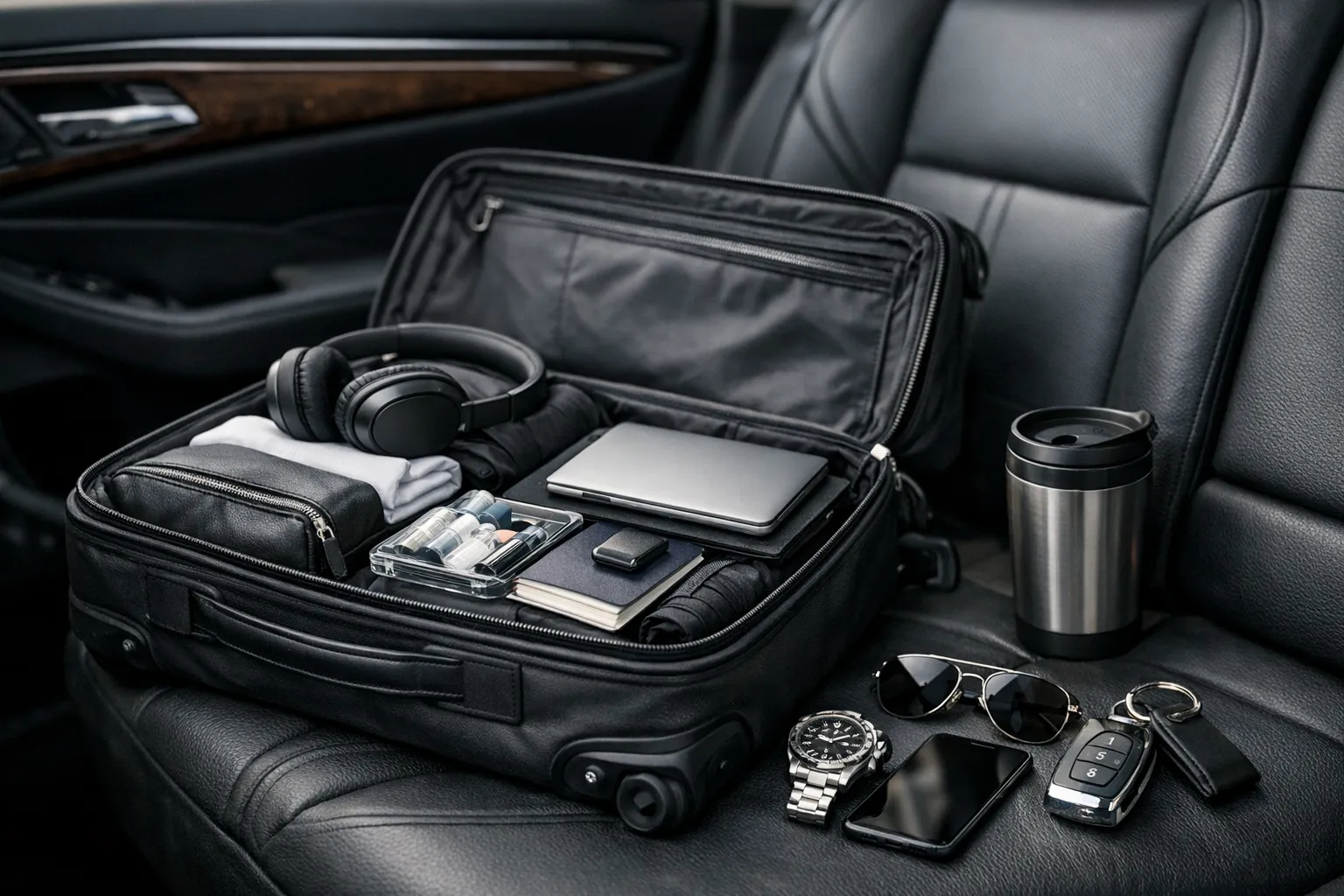
Baggage claim is a 35-minute tax. Most business travelers pay it every trip.
The carry-on-only strategy — done correctly — eliminates that tax permanently. No waiting at the carousel. No checked bag fees. No “your bag was misrouted to Dallas” the night before a client presentation.
This is the comprehensive, printable carry-on packing list for business travelers, organized by category and updated for 2026. Print it out, save it to your phone, or use it as the template for your own permanent packing list.
Note: a PDF version of this checklist is available for download at the end of this post.
The Standard Carry-On Setup
Before the list: the container matters.
You need two bags. A main carry-on (21–22 inches, the maximum for most airline overhead bins) and a personal item (a backpack or structured tote, which goes under the seat in front of you).
The main carry-on holds your clothing, toiletries, and anything you won’t need mid-flight.
The personal item holds your tech, documents, and anything you’ll access during the flight.
Keep them organized this way and you’ll never be the person climbing over three rows to get to the overhead bin mid-flight.
Tech Essentials
Laptop (fully charged, in your personal item for security checkpoint removal)
Laptop charger (coil and secure — a loose charger wraps around everything else)
Portable power bank (TSA limit: 100Wh = approximately 27,000mAh; 160Wh max with airline approval. Most travel banks are 20,000mAh/74Wh — well under the limit)
USB-C charging cable (2026 standard — also charges most phones and many laptops)
USB-A cable (legacy backup — many hotel room USB ports and older charging stations are still Type-A)
International power adapter (if traveling outside the US — a single multi-standard adapter handles most countries)
Noise-cancelling headphones or earbuds (Sony WH-1000XM5 or AirPods Pro — carry in personal item, use from taxi to plane)
Phone (fully charged, boarding pass downloaded to Wallet before you leave)
Wireless earbuds charging case with full charge
AirTag or Tile tracker (attach one to your carry-on bag and one inside your personal item — if a gate-checked bag gets lost, the tracker tells you exactly where it is)
E-reader or tablet (downloaded with books, articles, or documents for offline reading)
Presentation backup on USB drive (always. Cloud presentations fail. USB drives don’t.)
2026 Pro Addition:
eSIM setup for international travel (carriers like Airalo or T-Mobile’s international add-on give you data abroad without swapping physical SIMs — set it up before you leave, not at the airport)
Documents and Money
Passport (if international, or as a second ID — also accepted at TSA checkpoints)
Driver’s license or government-issued ID
Physical boarding pass backup (optional but useful if your phone battery dies)
Corporate credit card
Personal credit card (backup, stored separately from corporate card)
Cash: $100–200 in mixed bills (for taxis, tips, and any cash-only situations)
Hotel confirmation printout or screenshot (for hotels that require it at check-in)
Travel insurance card (with 24/7 emergency contact number written on it)
TSA PreCheck or Global Entry card (or Know your KTN — Known Traveler Number — in your phone notes to enter during booking)
Business cards (10–15 cards per meeting day; digital alternatives via HiHello or Popl for 2026)
Loyalty program membership numbers (airline, hotel — screenshot in phone photos for offline access)
2026 Pro Addition:
Digital business card (NFC card from Popl or HiHello app — tap-to-share on any iPhone or Android, no paper required)
Health and Comfort
TSA Liquids Reminder
The 3-1-1 rule: liquids must be in containers of 3.4 ounces (100ml) or less, all fitting in 1 quart-sized clear zip-lock bag, 1 bag per person. With TSA PreCheck, you don’t remove the bag at the checkpoint — but you still need to comply with the limits.
Quart-sized zip-lock bag (use it as your liquids organizer)
Toothpaste (travel size, 3.4oz or under)
Toothbrush (a foldable travel toothbrush saves space)
Deodorant (solid or travel-size liquid/gel)
Face wash or micellar water wipes (wipes don’t count as liquids — a travel hack worth knowing)
Moisturizer or face cream (cabin humidity is 10–15%; your skin will notice)
Lip balm (same reason as above; not counted as a liquid)
Eye drops (for dry cabin air — preservative-free individual vials pack well)
Hand sanitizer (2oz, in your liquids bag)
Prescription medications (in original pharmacy bottles where possible; bring documentation for controlled substances)
Over-the-counter essentials: ibuprofen/acetaminophen, antacids, antihistamine, antidiarrheal
Compression socks (wear them on the plane; don’t pack them)
Neck pillow (Trtl or Cabeau — folds small enough for an exterior backpack pocket)
Eye mask (Manta Sleep is the current standard; blocks light without pressing on eyes)
Earplugs (foam backup to headphones — under $2 per pair, invaluable if headphone battery dies on a 6-hour flight)
Clothing Essentials
The carry-on clothing system is built on three principles: neutral colors mix and match, wrinkle-resistant fabrics survive compressed packing, and overlap eliminates redundancy.
For a 3-night trip:
2 dress shirts (wrinkle-resistant fabric — Ministry of Supply and Mizzen+Main make the current best options for men; wrinkle-resistant blouses for women)
1 packable blazer (folds to the size of a sweater; Uniqlo Packable Jacket or a structured blazer in navy or charcoal works as business or casual)
2 pairs of dress trousers or business-appropriate bottoms (neutral tones — navy, grey, black)
1 pair of casual bottoms (for evening or off-day)
3 changes of underwear (one extra in case of luggage delay — this is your insurance policy)
3 pairs of socks (including one pair of compression socks worn on the plane)
1 undershirt or base layer (doubles as sleepwear for short trips)
Dress shoes (wear them on the plane; don’t pack them — they take the most volume)
1 pair of casual shoes or sneakers (pack them in a shoe bag — shoes go in the main carry-on, sole-to-sole)
Packing method: Roll casual items, fold dress items. Use packing cubes (Eagle Creek or Away) to compress volume by approximately 30% and keep your bag organized when you’re living out of it for 3 days.
Work Supplies
Notebook (a Field Notes or Moleskine pocket notebook — for analog backup when the app crashes mid-meeting)
2 pens (always 2 — one will run dry or be given to someone)
Printed meeting agenda or client brief (yes, paper — easier to annotate in a fast meeting than scrolling on a phone)
USB drive with presentation backup (covered in tech, but worth noting again here)
Business cards (covered above)
Folder or document holder for contracts, reports, or papers you’ll reference
TSA Compliance Guide
Getting through security without being pulled aside is a system, not luck.
What to remove at standard security (without PreCheck):
Laptop (out of bag, in its own bin)
Tablets over 7 inches (out of bag)
Liquids bag (out of bag, in its own bin)
Shoes and belt
Jacket and bulky outerwear
Metal in pockets (coins, keys, watch — into the bag, not the bin, to prevent loss)
With TSA PreCheck:
Laptop stays in bag
Liquids stay in bag
Shoes stay on
Belt stays on
You still need to remove items that trigger the metal detector — bulky metal in pockets causes nuisance alarms
At the checkpoint:
Have your boarding pass (phone or printed) and ID ready before you reach the agent, not when you’re standing in front of them
Pre-remove your laptop and liquids bag in the queue if you’re not PreCheck — it takes 15 seconds to do it while waiting and saves 45 seconds of fumbling at the belt
What to Pack in Your Personal Item vs. Main Carry-On
This distinction matters at the security checkpoint and during the flight.
Personal item (under-seat backpack or tote) — things you’ll use during the flight:
Laptop, charger
Headphones
Documents and wallet
Medications and comfort items (eye mask, neck pillow, lip balm)
Snacks
Phone and AirPods
Main carry-on (overhead bin) — things you won’t access mid-flight:
Clothing (in packing cubes)
Toiletries bag
Shoes (in shoe bag)
Power adapter
Anything you packed but probably won’t use
The 2026 Business Traveler Additions
These weren’t on packing lists five years ago. They should be on yours now.
Portable USB-C charger that doubles as a laptop charger — Anker 737 Power Bank (140W, USB-C) charges a MacBook Pro from 20% to 80% on a flight. Also charges your phone and earbuds simultaneously. One device replaces three.
eSIM card or international data add-on — Physical SIM swapping is outdated. Airalo sells destination-specific data eSIMs starting at $5 for 1GB. Set it up from the app before you leave. You’ll have data the moment you land.
Digital business cards — Popl’s NFC-enabled card ($20, one-time purchase) stores your contact, LinkedIn, calendar link, and any other URL you want. Tap it against any smartphone to share. More professional than paper, faster than scanning a QR code.
Noise-cancelling earbuds as primary, over-ear as backup — AirPods Pro 2 for calls and compact use. Over-ear headphones for flights. Both fit in a personal item.
AirTag in your carry-on — Even carry-on bags get gate-checked when overhead bins are full. An AirTag ($29) means you can track it from your phone if it doesn’t come back immediately.
The Short Pre-Flight Checklist
Use this the night before every trip:
The night before:
Download boarding pass to phone Wallet
Charge laptop, phone, earbuds, power bank to 100%
Lay out everything — see it before you pack it
Check your liquids bag is under the 3-1-1 limit
Confirm your transportation to the airport
The morning of:
Passport/ID in personal item (not main carry-on)
Corporate card accessible, not buried
Medications in personal item, not main carry-on
Boarding pass confirmed on phone
One Thing You Don’t Need to Pack
There’s one thing the prepared business traveler doesn’t need to worry about at all: how they’re getting to the airport.
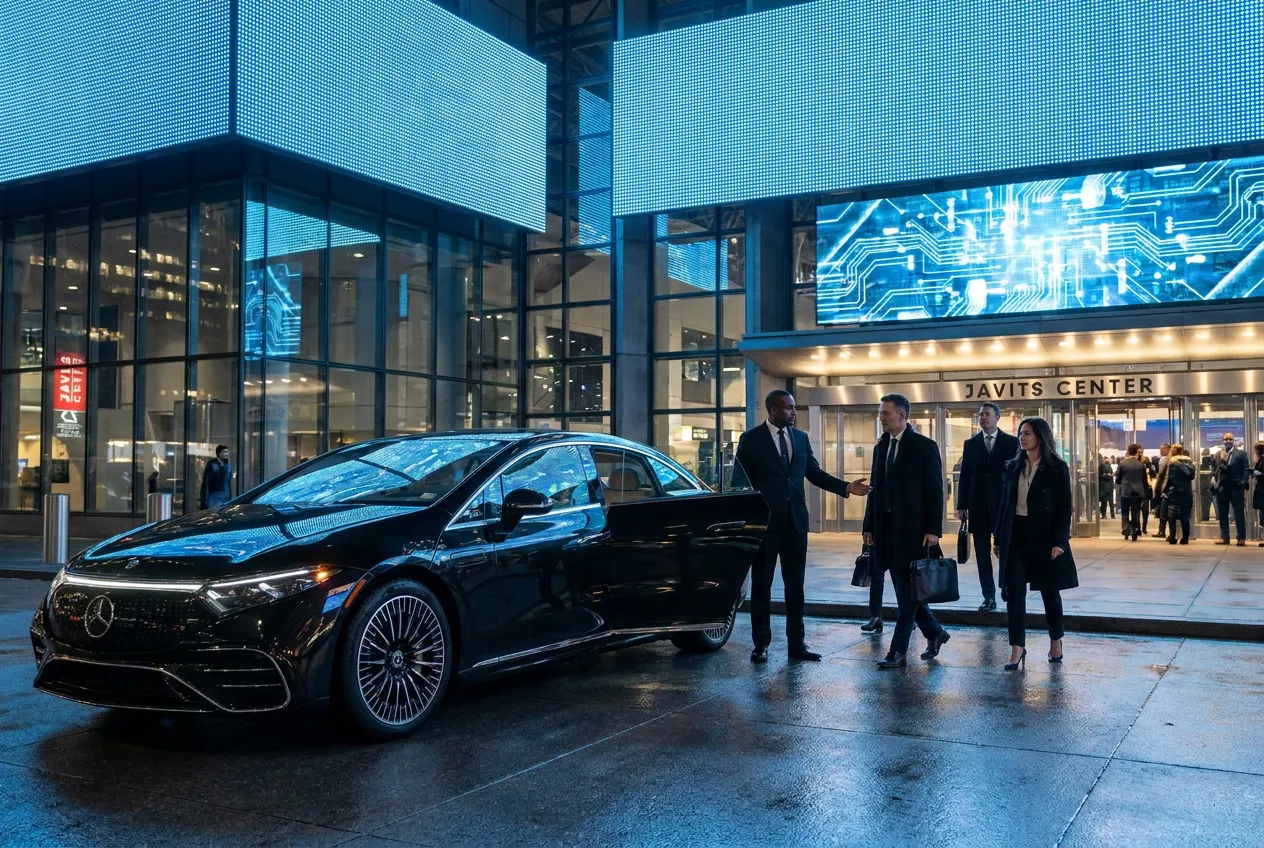
Pre-book your car before your trip and remove that variable entirely from your morning-of checklist. No surge pricing. No waiting for a driver to accept. No wondering if the cab will show up at 5:30am. Your car is confirmed, your driver knows your terminal, and the only thing left to do is show up.
For NYC-area travel — JFK, LGA, EWR and throughout the tri-state area — CoreCar handles exactly this. Pre-booked, professionally driven, with the fleet to match your travel needs: from the Volvo S90 and Audi A8L for executive transfers to the Cadillac Escalade and Lincoln Navigator for groups and oversize luggage.
Book at corecar.com before your next trip.
Last updated: March 2026. CoreCar serves JFK, LGA, EWR, and the greater NYC/NJ/CT tri-state area.